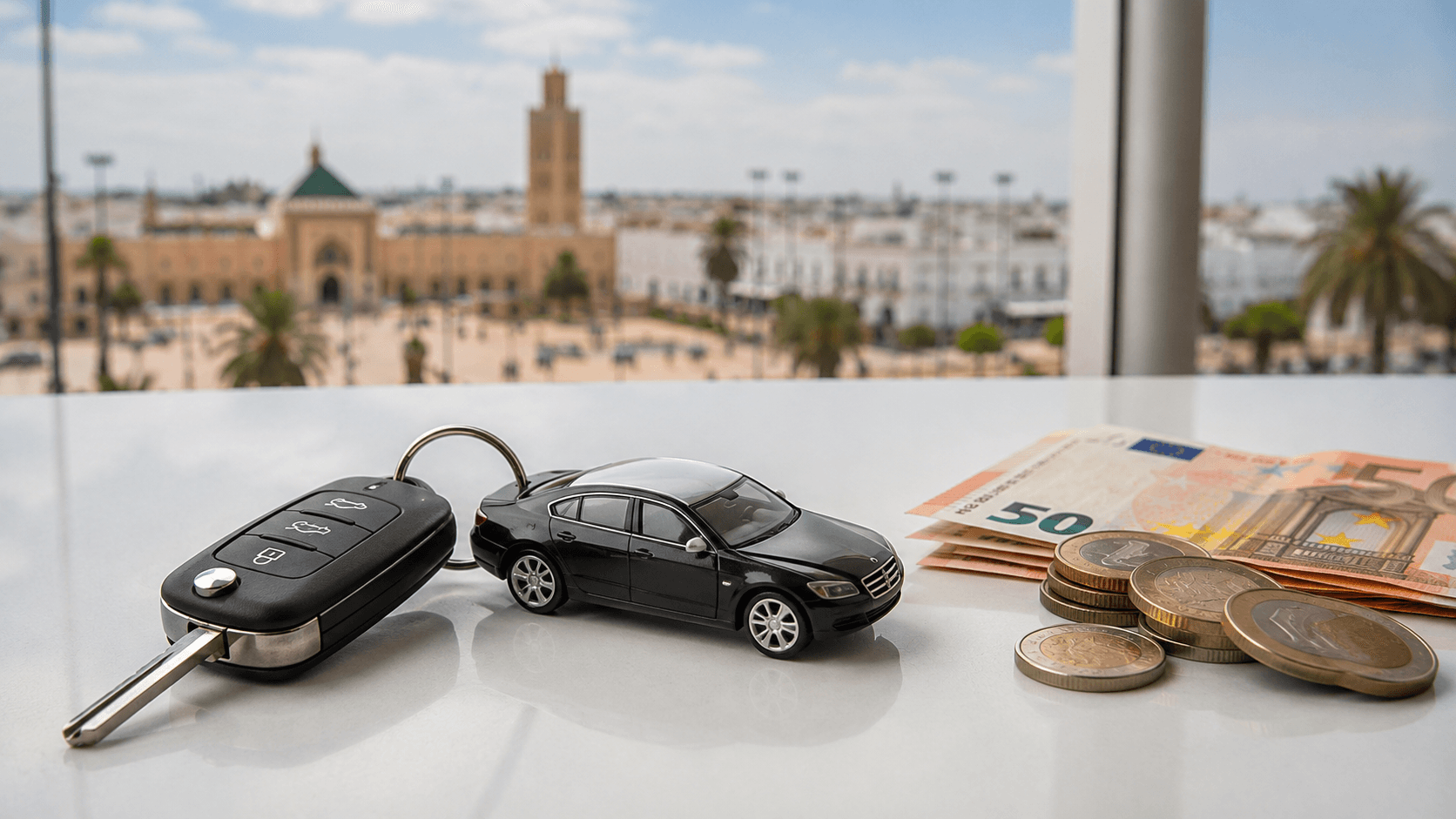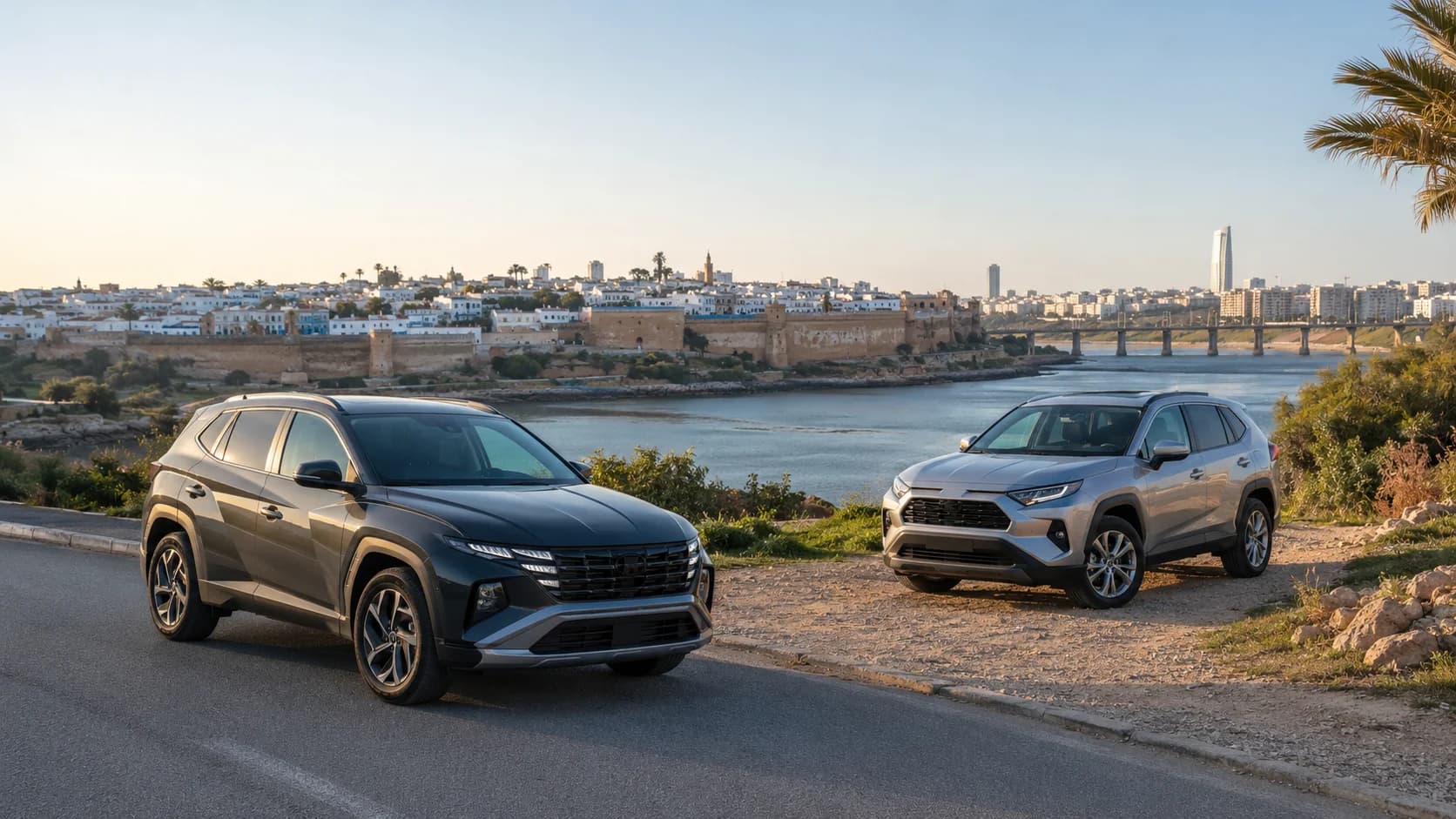









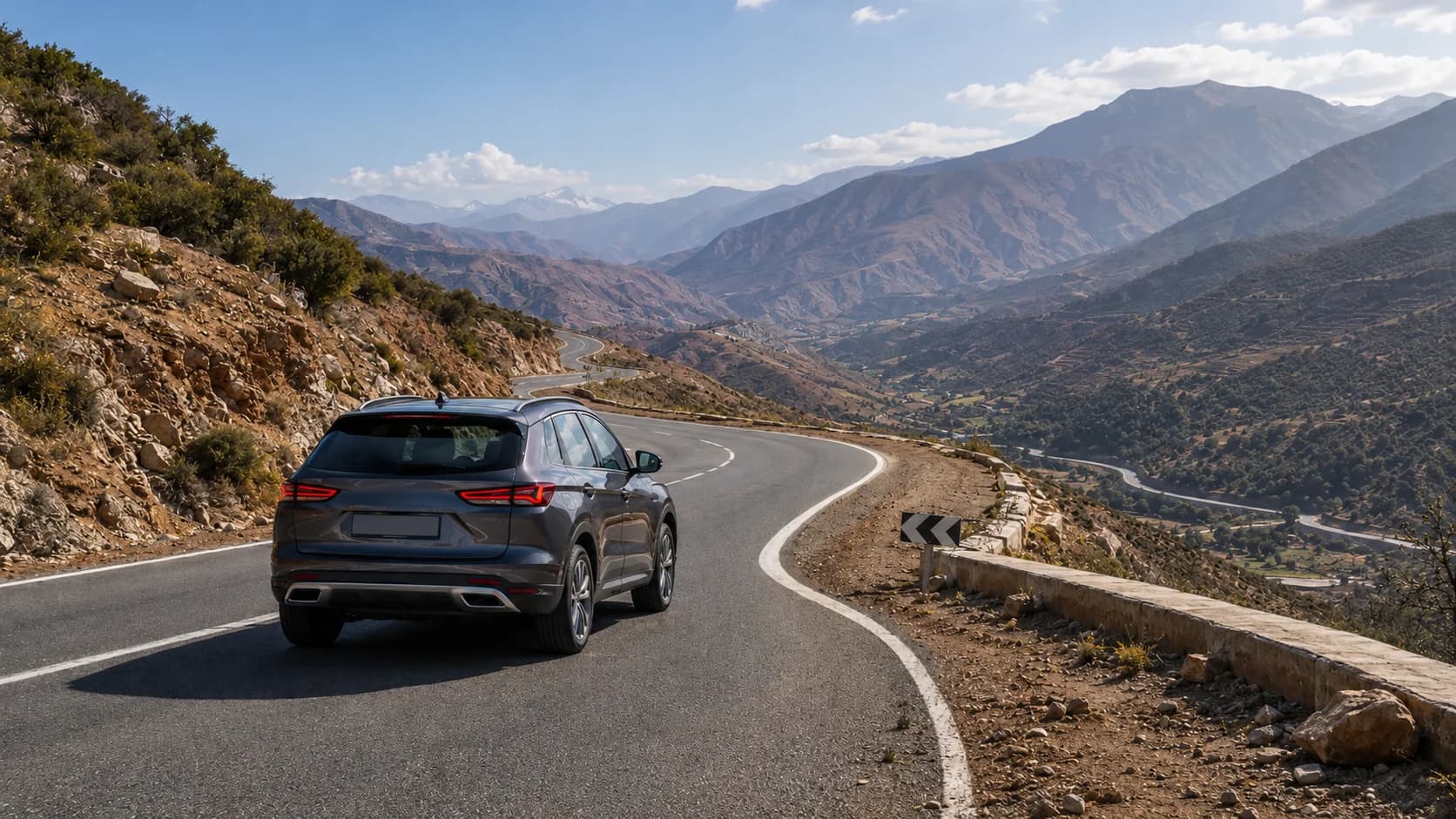
Driving from Rabat to the Atlas Mountains is one of the best ways to see how quickly Morocco’s landscape can change. You can leave Rabat on broad, relatively fast roads and, several hours later, find yourself driving through valleys, climbing mountain passes and following winding roads between small towns and villages.
For travelers planning driving from Rabat to Atlas Mountains, the biggest adjustment is not necessarily the distance. It is the change in road type, average speed, visibility, weather and the level of concentration required behind the wheel.
A sedan can handle many established Atlas routes perfectly well. An SUV can provide additional comfort, ground clearance and luggage space, while a 4x4 becomes useful mainly when your itinerary genuinely involves rougher roads or unpaved access.
This guide explains what actually changes when you leave the motorway-style environment around Rabat and begin driving deeper into the mountains.
Table of Contents
- Driving From Rabat to the Atlas Mountains
- How Mountain Driving Differs From Rabat
- Planning the Transition From Motorway to Mountain Roads
- Bends, Gradients and Slower Average Speeds
- Weather and Visibility
- Fuel and Rest-Stop Planning
- When a Normal Car Is Enough
- When an SUV or 4x4 Makes Sense
- Atlas Road-Trip Checklist
- Frequently Asked Questions
What Changes When Driving From Rabat to the Atlas Mountains?
The main difference is that distance becomes a less useful measure of journey time.
Around Rabat and on Morocco's major motorway network, driving can be relatively predictable. Mountain roads may introduce tighter bends, steeper gradients, slower vehicles, villages, changing visibility and sections where maintaining a high average speed is neither comfortable nor sensible.
For most established tourist routes:
-
paved roads are common
-
a normal sedan is often sufficient
-
an SUV can improve comfort on uneven or secondary roads
-
a 4x4 is not automatically required
-
daylight driving is generally easier for first-time visitors
-
extra time should be added to navigation estimates
The best rental vehicle is therefore the one suited to your actual route, rather than simply choosing the largest vehicle available.
Morocco's official motorway operator, Autoroutes du Maroc, confirms that Rabat connects directly into the country's major motorway network, including the A2 toward Meknes and Fes and the wider network linking central Morocco.
How Mountain Driving Differs From Rabat
Driving around Rabat generally means dealing with urban roads, junctions, roundabouts and faster intercity roads. Once you begin travelling toward the Atlas Mountains, the driving environment gradually changes.
The exact transition depends on your destination. You may initially cover a substantial part of the journey on a motorway or major national road before joining more rural routes.
That transition can bring:
-
narrower carriageways
-
more frequent curves
-
stronger elevation changes
-
slower trucks and local traffic
-
villages directly alongside the road
-
livestock or pedestrians near rural roads
-
fewer opportunities for overtaking
-
more variable road surfaces
-
longer gaps between major services
This does not mean Atlas driving is automatically difficult. It means you should stop thinking about the trip as a motorway journey once you enter mountainous terrain.
A driver who is comfortable at 100 or 120 km/h on a broad road may need to spend long sections travelling far more slowly once bends, villages and gradients increase.
Planning the Transition From Motorway to Mountain Roads
A good Rabat Atlas road trip should be planned in stages.
The beginning of the journey may be relatively straightforward. Rabat is directly connected to Morocco's motorway system, including the A2 east toward Meknes and Fes and other links through the wider national network.
Depending on your Atlas destination, however, the final portion of the journey may be very different.
You could travel:
Rabat → motorway → major regional road → mountain road → village or accommodation
Each transition changes what the driver should expect.
Do not plan using distance alone
A 150 km motorway section and a 150 km mountain section are not equivalent.
Navigation apps are useful for planning, but mountain travel deserves extra margin because conditions can change because of:
-
roadworks
-
slow vehicles
-
local traffic
-
weather
-
stops for fuel or food
-
photography stops
-
temporary road restrictions
-
reduced visibility
-
unfamiliar roads
If your navigation app predicts four hours, do not automatically schedule an activity exactly four hours after departure.
Give yourself breathing room.
Bends, Gradients and Slower Average Speeds
One of the biggest changes when driving from Rabat to Atlas Mountains is average speed.
The speed shown on your dashboard matters less than how consistently you can maintain it.
On a motorway, you may drive at a relatively stable speed for long periods. On mountain roads you may repeatedly:
accelerate, slow for a bend, climb, descend, follow another vehicle and pass through a village.
That lowers average speed considerably.
Mountain bends
Some mountain roads contain long, predictable curves. Others have tighter bends where visibility around the corner is limited.
The safest approach is simple:
Reduce speed before entering the bend rather than braking sharply halfway through it.
Stay clearly within your lane and do not assume that an empty-looking road will remain empty around the next corner.
Gradients
Climbing requires more engine effort, especially with several passengers and luggage.
Descending requires just as much attention.
Avoid relying continuously on the brakes during long descents. Use an appropriate lower gear where necessary so the engine helps control speed.
With an automatic vehicle, this may mean selecting a lower drive mode or manual gear setting where the vehicle provides one.
Overtaking
Do not feel pressured to overtake just because a local driver does.
Wait until you have:
-
sufficient visibility
-
enough road
-
no approaching traffic
-
a clearly legal overtaking opportunity
Arriving 10 or 15 minutes later is preferable to attempting an uncomfortable pass.
Weather and Visibility in the Atlas Mountains
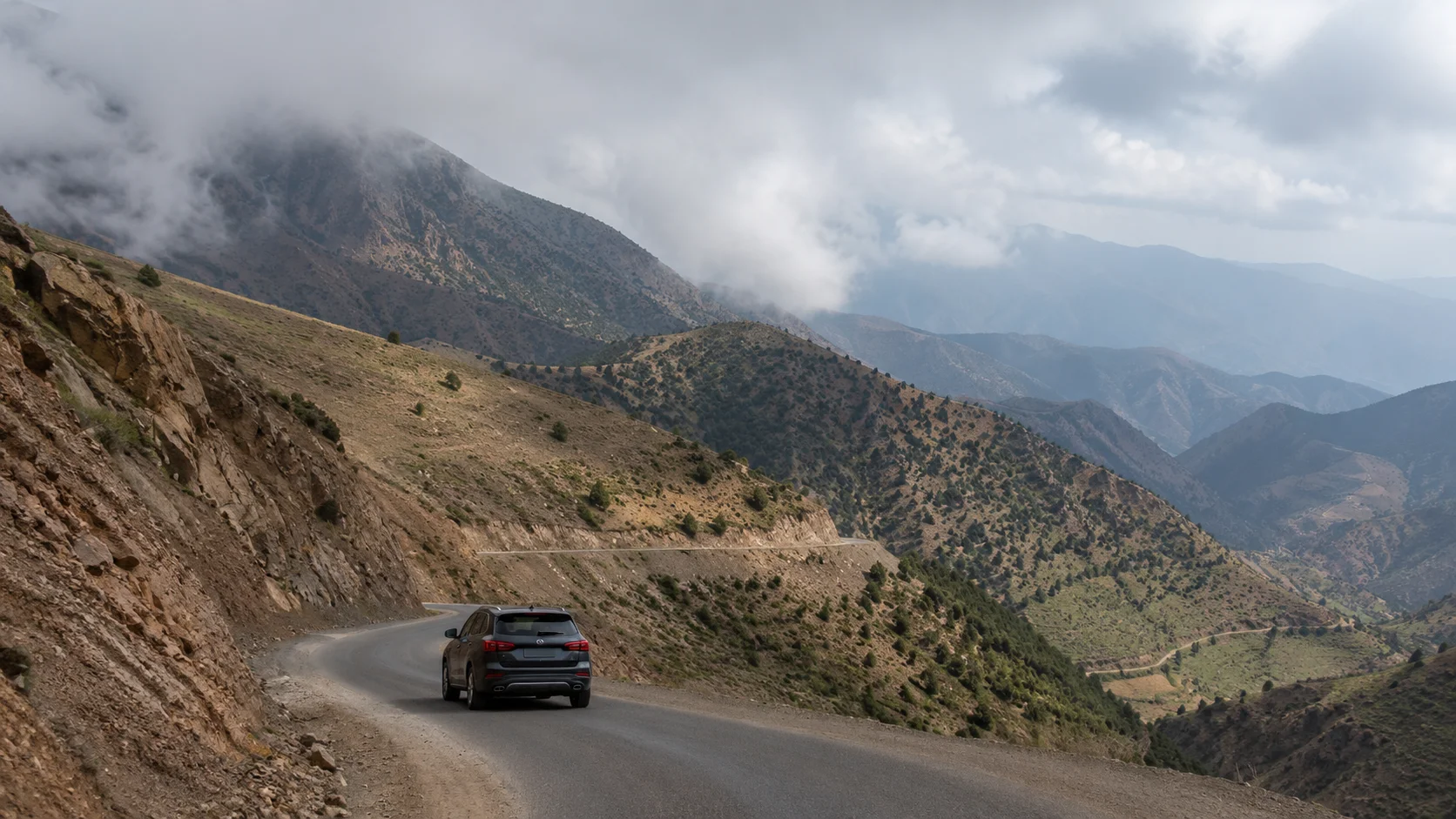
Weather is one of the most important differences between Rabat and higher mountain areas.
Conditions in Rabat do not necessarily tell you what conditions will be like several hours away and at a significantly higher altitude.
Depending on the season and destination, mountain driving can involve:
-
fog
-
rain
-
strong winds
-
colder temperatures
-
low cloud
-
snow or ice at higher elevations
-
sudden visibility changes
Winter driving
Higher Atlas routes can experience snow and freezing conditions in winter.
If your itinerary involves high mountain passes, remote areas or winter travel, check the specific road and local forecast before leaving.
A vehicle being technically capable of reaching a destination does not automatically mean the road is suitable to drive at that particular moment.
Summer driving
Summer removes many cold-weather concerns, but it brings different considerations.
Temperatures can become high at lower elevations, and long drives through exposed areas can be tiring.
Carry water and avoid planning an unnecessarily exhausting driving schedule.
Fog and low visibility
If visibility deteriorates:
slow down, increase following distance and use the appropriate vehicle lights.
Do not attempt to maintain your previous speed simply because you know the road is supposed to be open.
Fuel and Rest-Stop Planning
Fuel planning becomes increasingly important the farther you move from major towns.
You will find fuel stations throughout Morocco, but the distance between convenient stations can increase on rural or mountain routes.
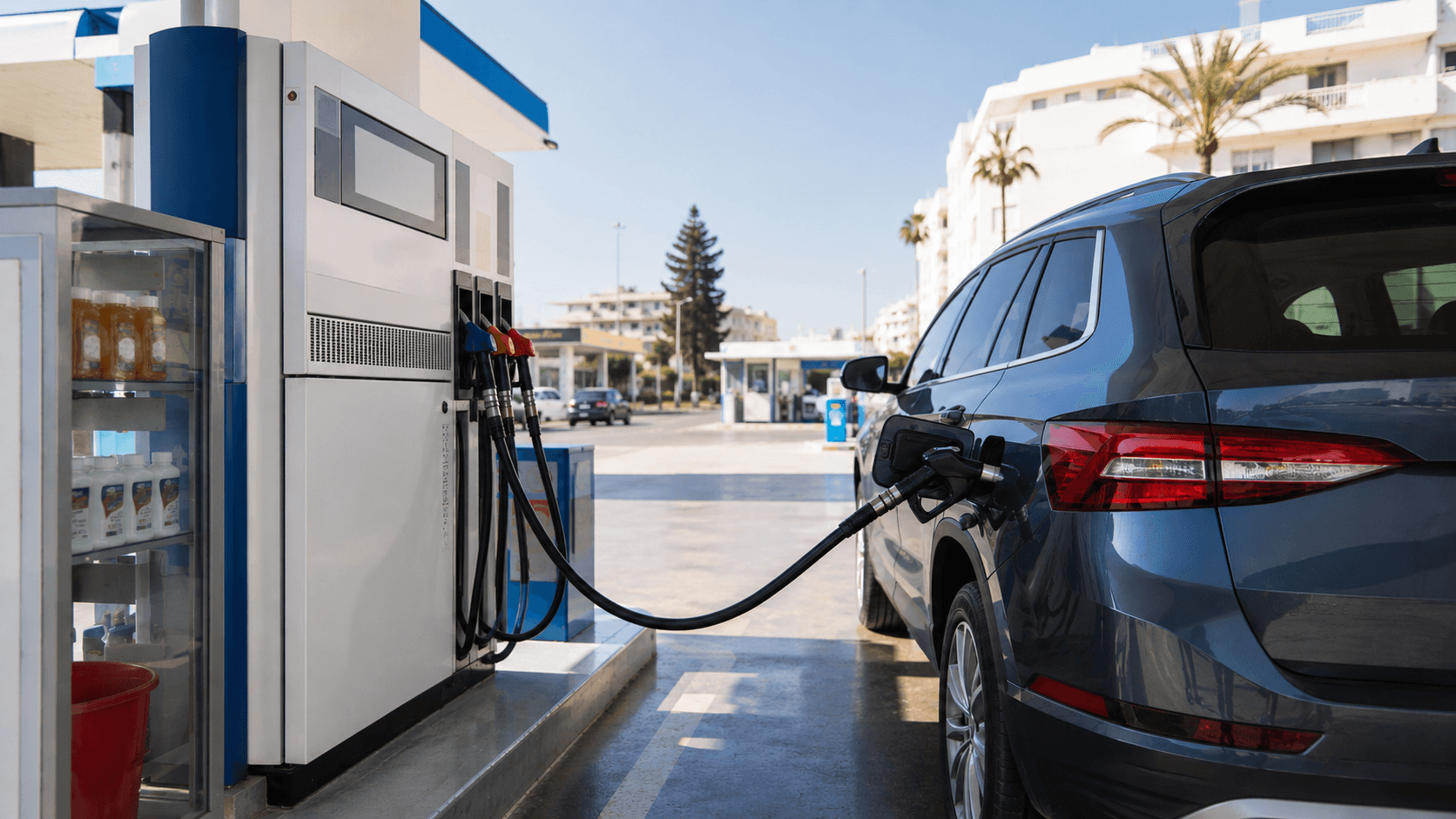
The easiest strategy is not to wait until the fuel warning light appears.
Refuel before entering remote mountain sections
If you are approaching a smaller road or a long rural section, refuelling in the last significant town is usually sensible.
That gives you flexibility if:
-
the next station is farther away than expected
-
your route changes
-
a station is closed
-
you decide to take a scenic detour
-
mountain gradients increase fuel consumption
Rest before the difficult section
Fuel stops are also useful opportunities to reset driver concentration.
If the final 80 km of your journey contains most of the bends and climbing, take your break before that section rather than waiting until you are already tired.
A short stop for coffee, food or stretching can make mountain driving considerably more comfortable.
When a Normal Car Is Enough
One of the most common misconceptions about mountain driving in Morocco is that every Atlas journey requires a 4x4.
It does not.
Many towns and popular destinations are connected by paved roads that are regularly used by ordinary cars.
A standard sedan may therefore be perfectly suitable when:
-
your route stays on major paved roads
-
you are travelling in normal weather
-
you are staying in towns or easily accessible hotels
-
your luggage fits comfortably
-
you do not plan to drive on rough tracks
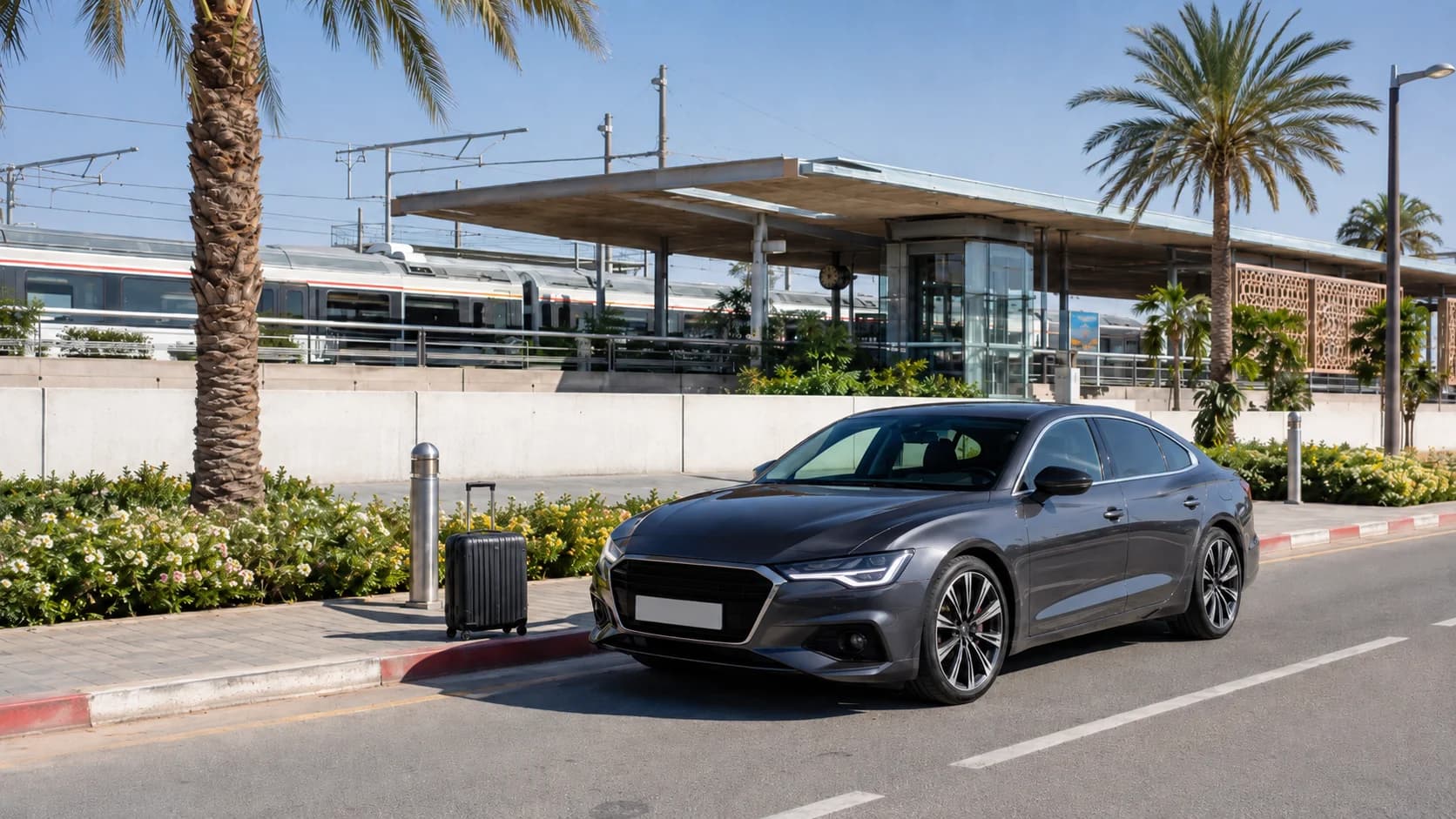
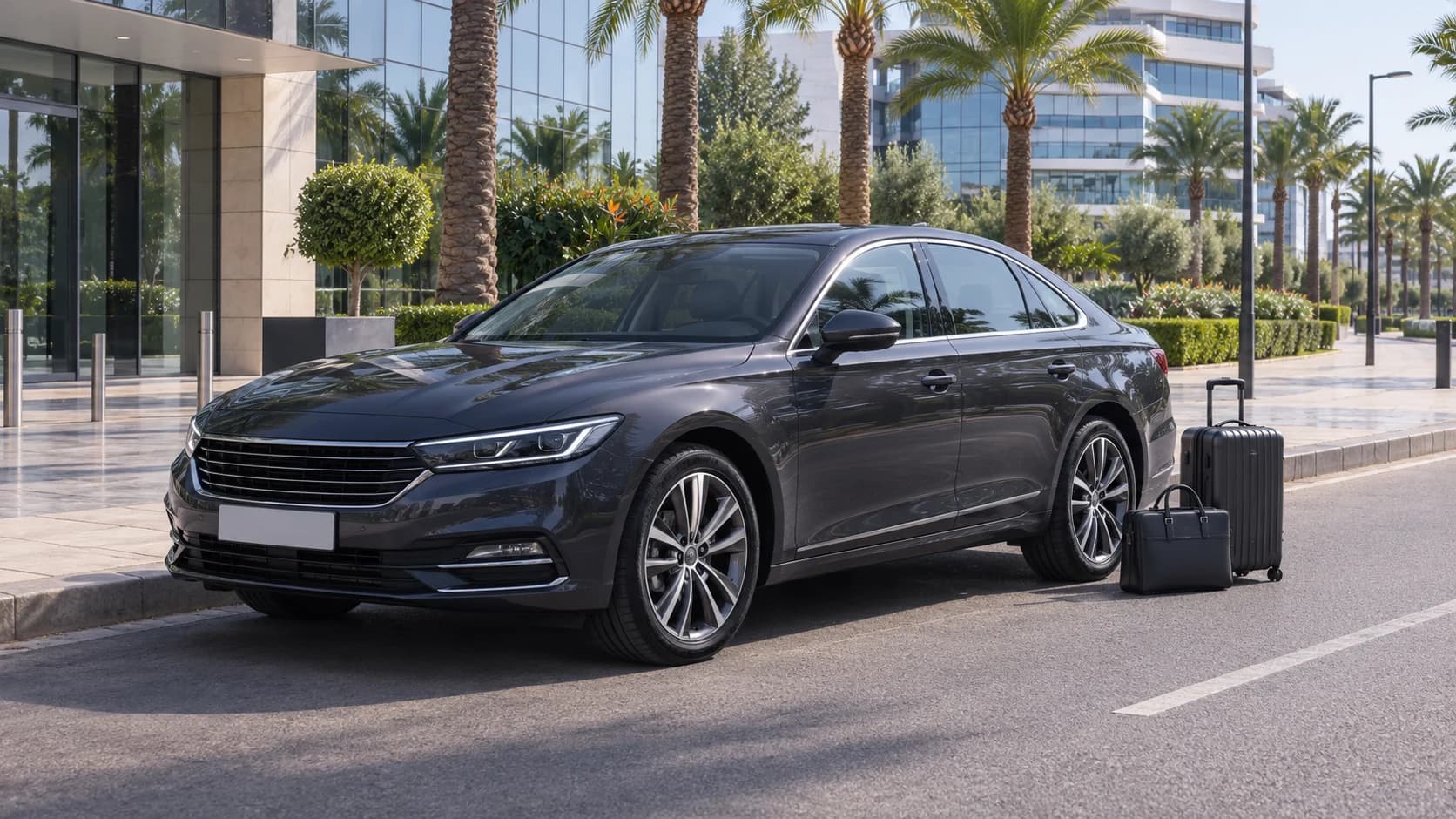
For travelers following established paved routes, a [sedan rental in Rabat] can be a practical combination of comfort, fuel economy and luggage capacity.
A sedan may actually be preferable to a large vehicle if you are confident that your itinerary remains on normal roads.
Consider luggage as well as road conditions
Vehicle choice is not only about ground clearance.
Four adults with large suitcases may appreciate an SUV more than two adults travelling with cabin bags, even when both groups follow exactly the same road.
Choose based on:
road surface + passenger count + luggage + season + destination.
When an SUV or 4x4 Makes Sense
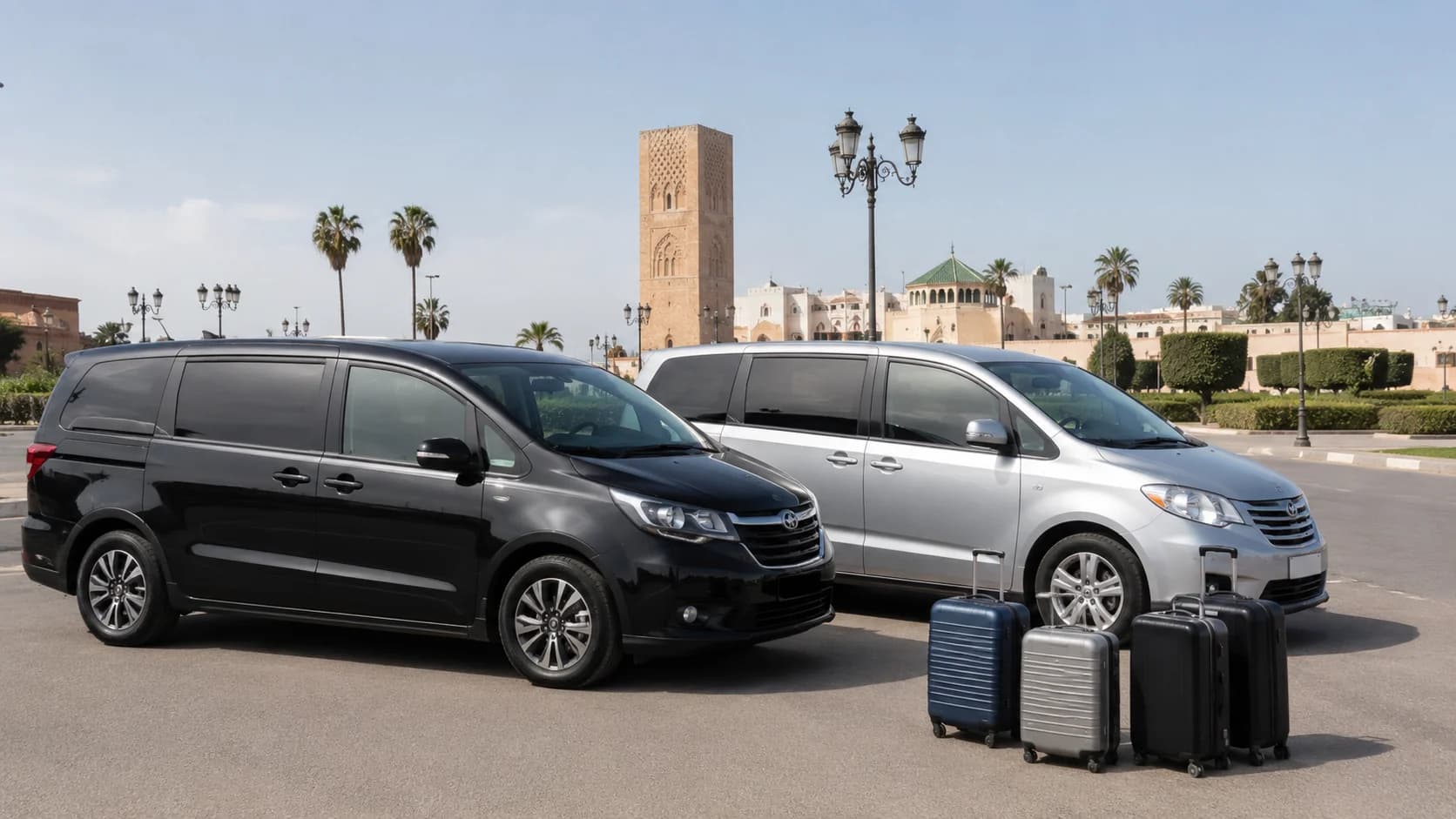
An SUV becomes more attractive when your itinerary involves secondary mountain roads, heavier luggage, several passengers or areas where surfaces may be less consistent.
An [SUV rental in Rabat] can provide:
-
higher seating position
-
additional luggage space in many models
-
increased ground clearance
-
greater comfort on uneven surfaces
However, SUV and 4x4 are not interchangeable terms.
Some SUVs are primarily designed for paved-road comfort and may not have true four-wheel-drive capability.
When a 4x4 is genuinely useful
A [4x4 rental in Rabat] becomes more relevant if your itinerary specifically includes:
-
unpaved tracks
-
rough rural access roads
-
remote accommodation
-
off-road approaches permitted by the rental conditions
-
more demanding mountain terrain
Even then, having a 4x4 does not make every road safe.
Road closures, deep snow, flooding or severe surface damage can stop a capable vehicle just as effectively as a normal car.
Never treat four-wheel drive as permission to ignore local road conditions.
Do not overspecify the vehicle
If your entire itinerary is Rabat → major roads → established mountain town → paved hotel access, paying for a 4x4 may add very little practical benefit.
If your route includes gravel tracks, rural accommodation or uncertain access, the extra capability may be worthwhile.
That distinction matters.
Driver Confidence Matters as Much as the Car
The correct vehicle helps, but the person driving is still the most important factor.
First-time visitors to Morocco can manage many Atlas routes comfortably if they:
-
drive during daylight
-
avoid rushing
-
take breaks
-
allow faster local traffic to pass safely
-
avoid unnecessary overtaking
-
reduce speed before bends
-
plan fuel in advance
Someone who rarely drives mountain roads should not design an itinerary that requires six or seven hours of technically demanding driving immediately after arriving in Morocco.
Start early
An earlier departure provides several advantages.
You have more daylight, more time for stops and more flexibility if the journey takes longer than expected.
You also avoid reaching the most demanding part of the route after dark.
For first-time mountain drivers, this can make a substantial difference.
Route-Specific Preparation
"The Atlas Mountains" covers an enormous area, so there is no single Rabat-to-Atlas driving route.
Your preparation should depend on your actual destination.
A trip toward Beni Mellal is different from a journey into the Middle Atlas around Ifrane or Azrou, and both are different from reaching remote High Atlas villages.
Before departure, identify:
Your final destination: Not simply "the Atlas."
Highest elevation: Higher routes can experience very different weather.
Last major town: Useful for fuel, food and supplies.
Final road surface: Especially important for rural accommodation.
Arrival time: Avoid an unnecessarily difficult final approach after dark.
Mobile coverage: Download offline navigation if travelling somewhere remote.
Accommodation access: Ask whether the final access road is paved and whether standard cars regularly reach the property.
This final question can often tell you more about vehicle requirements than a generic recommendation to rent an SUV.
Atlas Road-Trip Checklist
Before driving from Rabat into the mountains, confirm:
-
your exact destination
-
the expected road surface
-
current weather conditions
-
daylight hours
-
fuel level
-
tyre condition
-
spare tyre or repair equipment supplied with the vehicle
-
navigation and offline maps
-
water
-
sufficient journey-time margin
-
accommodation access instructions
Also check the rental conditions before using the car on any unpaved or off-road section.
Choosing the Right Rental Car in Rabat
There is no single "best" rental car for every Atlas journey.
For paved main routes and two to four travelers, a sedan will often be sufficient.
For additional space, comfort and clearance, an SUV can be useful.
For genuinely rougher or more remote itineraries where four-wheel-drive capability is relevant, consider a 4x4.
MarHire Car Rabat offers sedan, SUV and 4x4 options, allowing travelers to match the vehicle to the route rather than simply choosing the largest category.
Mileage conditions should also be confirmed for your booking. MarHire rentals of seven days or more generally include unlimited kilometres, while shorter rentals may use a daily kilometre allowance depending on the vehicle and booking conditions.
Frequently Asked Questions
Is it difficult to drive from Rabat to the Atlas Mountains?
Not necessarily. The first part of many journeys uses major roads or motorways, while the mountain section requires slower, more attentive driving. Travelers comfortable with bends, gradients and rural roads can manage many popular routes without difficulty.
Do I need a 4x4 for the Atlas Mountains?
No. Many popular Atlas destinations are accessible using paved roads and ordinary cars. A 4x4 becomes more useful for rough, unpaved or genuinely remote routes.
Are Atlas roads paved?
Many principal roads connecting towns and popular destinations are paved. Secondary roads, rural access roads and tracks can vary considerably, so check the final section of your specific route.
How much slower is mountain driving?
There is no universal average. Mountain sections can be considerably slower than motorway driving because of curves, gradients, villages, traffic and limited overtaking opportunities. Plan using realistic journey time rather than distance alone.
What weather should I expect?
It depends heavily on altitude, season and location. Higher Atlas areas can experience colder temperatures, fog, snow and ice in winter, while summer conditions can be hot and dry at lower elevations. Check the forecast for the actual mountain destination rather than relying on Rabat weather.
Where should I refuel before mountain roads?
A useful rule is to refuel in the last substantial town before entering a long or remote mountain section, even if the tank is not yet close to empty.
Is a sedan enough for main Atlas routes?
Often, yes. If the route is paved, weather conditions are normal and your luggage fits comfortably, a sedan can handle many established Atlas journeys.
What is the safest time of day to drive?
Daylight is generally the easiest choice, particularly for drivers unfamiliar with the route. Leaving Rabat early also creates more time for stops and unexpected delays.
Can first-time Morocco drivers manage Atlas roads?
Yes, provided they choose an appropriate route, drive conservatively and avoid an overly demanding itinerary. Starting with main paved mountain roads is easier than heading immediately toward remote tracks.
Which rental car is best for a mountain trip?
A sedan is usually sufficient for paved main routes, an SUV provides extra space and ground clearance, and a 4x4 makes sense where your confirmed itinerary includes rougher terrain. The best vehicle depends on the actual road rather than the word "mountains."
Final Advice: Choose the Vehicle for the Road You Will Actually Drive
Driving from Rabat into the Atlas Mountains can be one of the most rewarding parts of a Morocco road trip.
The important change is not simply altitude. It is the transition from fast, predictable roads to routes where bends, gradients, villages, weather and visibility can significantly reduce your average speed.
Allow extra time. Refuel before remote stretches. Check the weather. Try to complete unfamiliar mountain sections during daylight.
Most importantly, choose the vehicle according to your itinerary.
A sedan is perfectly capable on many paved Atlas routes. An SUV adds useful clearance and comfort. A 4x4 should be chosen when your route genuinely calls for its additional capability.
Planning an Atlas road trip from Rabat? MarHire Car Rabat can help you compare sedans, SUVs and 4x4s according to your destination, passengers, luggage and road conditions before departure.